Most enterprise AI acquisitions end the same way: a big announcement, a lot of promises, andthen… silence. This one didn’t. ServiceNow bought Moveworks and actually shipped the integration — turning it into working products you can deploy today. The result is two new additions to the ServiceNow AI Platform: EmployeeWorks and Autonomous Workforce.
If you run ServiceNow, or you’re evaluating it, this is worth understanding properly —because it changes how employees interact with the platform, and what theplatform can do on their behalf.
Here’s the plain-language version of what happened, why it matters, and where it actually earns its keep.
Before the acquisition, Moveworks was already one of ServiceNow’s 100+ technology integrations. It was known for three things:
ServiceNow, meanwhile, brought two decades of workflow automation, governance, and the orchestration muscle to make all of that execute reliably at enterprise scale.
The combination is the point. Moveworks is the friendly, consumer-grade front door; ServiceNow is the governed engine behind it.
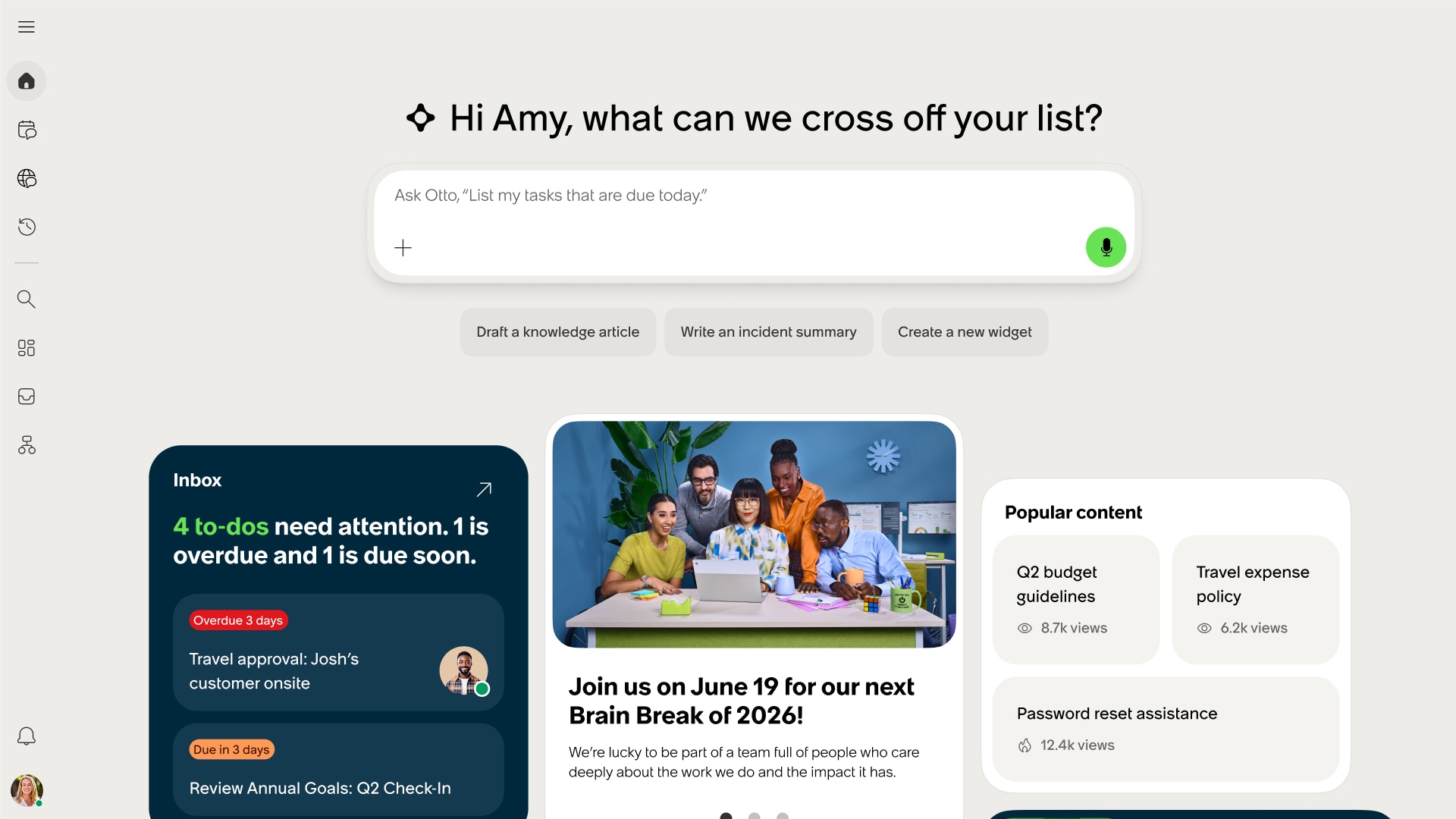
The headline product of the integration is EmployeeWorks. It combines Moveworks’ conversational AI and enterprise search with ServiceNow’s unified portal and autonomous workflows.
The idea is simple to describe and surprisingly hard to deliver: one entry point where an employee asks in natural language, and the request moves from question to completed work — across whatever systems it needs to touch, without the employee bouncing between five different tools.
The important distinction from a traditional chatbot: a chatbot answers a question and hands you a link. EmployeeWorks submits the form, triggers the workflow, routes theapproval, and closes the loop — inside your governance model. For organizations already running the ServiceNow Employee Center, there’s a dedicated plugin that embeds the Moveworks assistant directly into Employee Center and EmployeeCenter Pro, replacing the standard Virtual Agent.
The secondp iece is more ambitious. Autonomous Workforce introduces what ServiceNow calls AI specialists — and the framing matters. An AI agent handles a task inside a larger process. An AI specialist is assigned to a role, with a defined scope, business context, and the same permissions a human in that role would have, and it’s built to handle a job end-to-end.
The first one out of the box is the Level 1 Service Desk AI Specialist. ServiceNow has been running it internally, where its autonomous workforce handles over 90% of employee IT requests — and, according to ServiceNow’s own early figures,resolves those cases 99% faster than when they’re handled by human agents. Customer service, HR, finance, and security operations are flagged as the next specialist roles.
Beyond the demos, here’s where this integration creates real value:
1. Adoption you don’t have to fight for. The hardest part of enterprise AI isn’t the technology — it’s getting people to use it. Moveworks earned genuine adoption because it was easy. Bolting that front end onto ServiceNow’s back end means employees engage with a tool they like, while IT gets execution it can trust.
2. Governance is built in, not bolted on. This is the part European organizations should pay closest attention to. Every action runs through ServiceNow’s workflow layer and the AI Control Tower: role-based access control, approval chains, audit trails, and traceability on every step. The AI doesn’t bypass your governance model — it operates inside it. For anyone working under GDPR and strict compliance requirements, “the AI acted, andhere’s the full audit trail” is not a nice-to-have.
3. Deterministic outcomes, not probabilistic guesses. Language models on their own are probabilistic — ask the same question twice, get two different answers. The enterprise needs the opposite: predictable, governed, repeatable outcomes. By pairing Moveworks’ reasoning with ServiceNow’s deterministic workflow orchestration, you get intelligence that interprets and execution you can rely on.
4. Reachacross the whole stack. Because the search and action layer connects to 100+ systems out of the box, the value isn’t confined to ServiceNow itself. Legacy, custom, or proprietary systems can be brought in through Agent Studio without starting from scratch.
The integrationisn’t an “IT thing.” Here’s where organizations are putting it to work:
Early adopters across healthcare, retail, and public sector — including names like CVS Health, Siemens Healthineers, and the City of Raleigh — are already live, which tells you this isn’t a lab experiment.
Here’s the honest part: the technology is powerful, but the value depends entirely on the foundation underneath it. An AI front door is only as good as the workflows, data quality, permissions, and governance model it sits on top of. Deploy it on a shaky CMDB and messy processes, and you’ve automated the mess.
That’s exactly the groundwork we do. As a 100% pure-play ServiceNow partner, we help organizations across Europe get the foundation right — clean data, well-defined workflows, and a governance model that holds up — so that EmployeeWorks andAutonomous Workforce deliver real, governed value rather than another underusedtool.
If Moveworks and ServiceNow are on your roadmap, the best time to get the foundation rightis before go-live.
👉 Let’s talk about what it takes to do itright for your organization: https://atlafy.com/contact-us
100% ServiceNow consulting and implementation player

We help modern businesses leverage the ServiceNow platform