What used to be Now Assist has evolved into something much bigger — and it matters whether you’re still evaluating ServiceNow or already running it.
Enterprise AI has a dirty secret: most of it answers questions but never actually finishes anything.
You ask your HR chatbot about your parental leave policy.It gives you a document link. Then you open the portal. Then you find the right form. Then you wait for an approval email. Then you follow up. Then the work gets done — by you, manually, just as before, only with an AI detour added in the middle.
ServiceNow has a name for this problem: the completion gap. And at Knowledge 2026, held in Las Vegas in May 2026, they unveiled what they’re betting will close it for good: ServiceNow Otto.
If you’ve been following the ServiceNow roadmap, you know Now Assist. Launched as the platform’s native generative AI layer, it brought real capabilities to ServiceNow users: incident summarization, smart search, code generation for developers, case categorization for agents. It was genuinely useful — and also clearly just the first chapter.
In March 2025, ServiceNow made its largest acquisition ever: Moveworks, a leading enterprise conversational AI company, for approximately $2.85 billion. Moveworks brought something Now Assist lacked: across-system conversational layer that could understand employee intent and act across multiple platforms — not just inside ServiceNow.
Then, at Knowledge 2025, ServiceNow previewed AI Experience: a new AI-native interaction framework designed for multimodal, agentic orchestration.
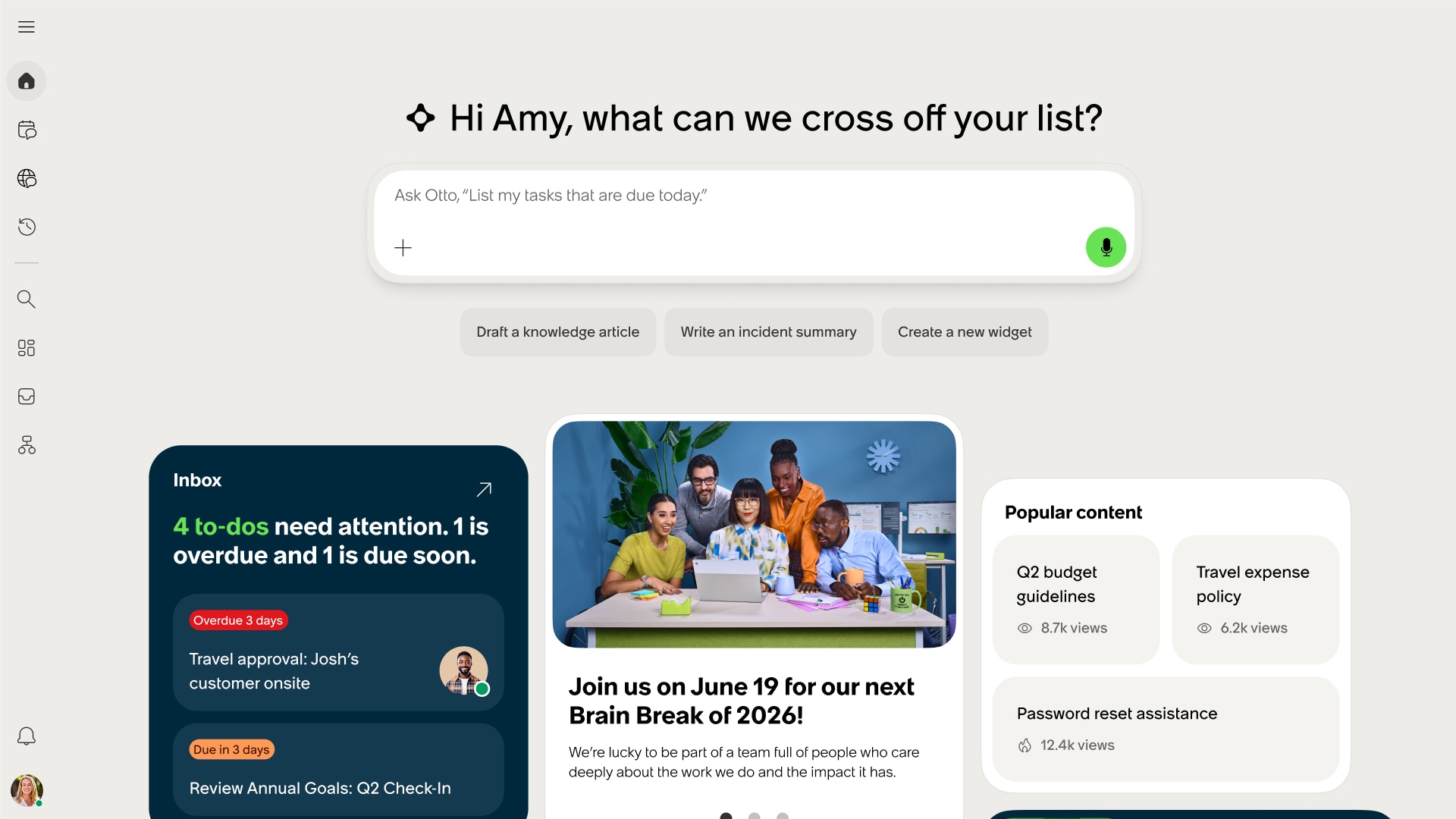
Otto is the convergence of all three. Announced on May 5, 2026, Otto unifies Now Assist, Moveworks, and AI Experience into a single AI experience running on a newAI-native architecture. One interface. One context. Every workflow.
The best way to understand Otto is through what it’s designed to not be: a smarter search bar, a Q&A bot, or a copilot that hands work back to you. Otto is designed to complete work. Here’s how.
Employees submit requests in plain language. “I need access to the Salesforce sandbox.” “My laptop keyboard is broken.” “Can I book a desk in the London office for Tuesday?”
Otto understands the intent, determines which workflow handles it, and executes or routes it — without the employee needing to navigate a service catalog, know which department to contact, or fill out a form. Context travels between interactions, so a follow-up doesn’t start from scratch.
This is the Moveworks capability now embedded at the platform level.
Otto searches across documents, wikis, knowledge bases, internal databases, SharePoint, and enterprise applications — and personalizes results based on the employee’s role, location, and department.
This isn’t a keyword search. It’s contextual retrieval:the same query from a junior analyst and a regional manager may return different, appropriately scoped answers.
Otto includes AI voice agents supporting multiple languages, making it accessible across shop floors, field teams, and any environment where typing isn’t practical. This is particularly significant for enterprises with a substantial frontline workforce.
Employees can ask data questions in plain language and get answers — no dashboards to navigate, no waiting for a BI report. “How many P1 incidents were resolved last quarter?” Just ask.
Every Otto interaction is logged, governed, and auditable through AI Control Tower — ServiceNow’s enterprise AI governance framework.
For decision-makers worried about enterprise AI going rogue: this is the answer to that concern. Control Tower ensures every decisionOtto makes is explainable and traceable. As of Knowledge 2026, it also integrates with major LLM providers and cloud platforms — Microsoft Azure, AWS,Google Cloud — as well as SAP, Oracle, and Workday. It can now discover non-human identities and connected devices, bringing IoT and OT systems under the same governance umbrella as AI agents.
The message: Otto doesn’t guess. It acts on your business context, your policies, your data — and leaves an audit trail.
If you’re evaluating ServiceNow as a platform investment, the Otto announcement changes the calculus in a few important ways.
• AI is no longer an add-on. On April 9, 2026, ServiceNow restructured its commercial model: AI is now bundled into every product by default. There’s no separate SKU to negotiate, no integration project to scope.You’re buying a platform where Otto is the front door.
• The ROI case got more concrete. Real-world numbers a restarting to emerge. Rolls-Royce deployed Now Assist — internally branded“Merlin” — in August 2025 across 12,000 employees. Within months: a 54% IT ticket deflection rate, 38,000 incidents resolved via predictive intelligence, and 300,000 shop floor hours returned to engineers. Now Assist was the predecessor. Otto is what comes next.
• Cross-system reach matters for your architecture conversation. Unlike AI tools locked inside a single application, Ottois designed to operate across departments and systems. Your implementation strategy should think beyond ServiceNow boundaries.
For organizations that have invested in Now Assist or are on a recent ServiceNow version, Otto represents a meaningful evolution of what you already have — not a rip-and-replace.
• Your Now Assist work carries forward. Summarization, categorization, smart recommendations, code generation — all of that is still there. Otto builds on top of it.
• The front door changes. EmployeeWorks is now generally available and is where Otto currently lives, alongside AI Control Tower. Over the coming year, ServiceNow will extend Otto across its full product portfolio.
• Adoption patterns may shift. An employee who never navigates a service catalog or learns a portal can still get work done thrugh a natural language conversation. That changes your user adoption strategy, your training investment, and your business case for the platform.
• The governance question is addressable. If your organization has been cautious about deploying AI at scale because of auditability concerns, Control Tower gives you a structured answer. This is particularly relevant for regulated industries — financial services, healthcare, life sciences.
It’s worth placing Otto in the broader enterprise AI landscape. Microsoft has Copilot. SAP has Joule. Salesforce has Agentforce. Each of these is a conversational AI layer across a major enterprise platform.
What differentiates Otto’s positioning is the claim that it doesn’t just respond — it orchestrates. The integration of Moveworks givesOtto a proven track record of cross-system action, not just in-platformassistance. Whether that differentiation holds up in practice across different customer environments is a question that will be answered in the next 12–18months as rollout matures.
What’s clear is that ServiceNow is making a deliberate bet: the enterprise doesn’t need more AI assistants. It needs one AI layer thatcan actually finish things.
Whether you’re at the beginning of your ServiceNow journey or you’ve been running the platform for years, Otto represents a shift in what enterprise AI looks like on this platform — and in what you should expect from it.
For new implementations: AI is part of the deal now.Build your business case and architecture with that in mind.
For existing customers: your investment in Now Assist is the foundation, not the ceiling. The completion gap is the next problem on the roadmap — and Otto is ServiceNow’s answer to it.
The question isn’t whether to take AI seriously in yourServiceNow strategy. It’s how fast you move to close your own completion gap.
At Atlafy, we help organizations navigate ServiceNow strategy, implementation, and optimization. If you’d like to understand what Otto means for your specific environment, let’s talk.
100% ServiceNow consulting and implementation player

We help modern businesses leverage the ServiceNow platform